SULFUR AS A SOURCE OF HIGH‑VALUE MATERIALS
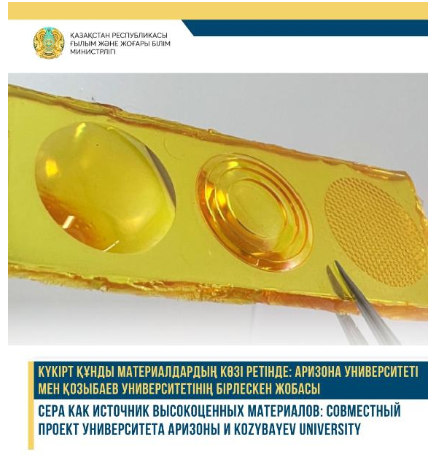 SULFUR AS A SOURCE OF HIGH‑VALUE MATERIALS: A JOINT PROJECT OF THE UNIVERSITY OF ARIZONA AND KOZYBAYEV UNIVERSITY
Kazakhstan ranks 7th in the world in sulfur production, with a total production volume of about 4.3 million tons per year. At the same time, its export generates only ~$200–400 million. Today, elemental sulfur, as a by‑product of the oil and gas industry, is mainly exported from Kazakhstan in its raw form or used to produce low‑margin sulfuric acid. However, its excessive accumulation creates associated environmental risks. Given the growing volume of production at the fields, the task of transitioning from exporting raw materials to deeply processing sulfur into innovative and high‑value materials is becoming particularly relevant.
A project by a group of scientists from the University of Arizona (USA), led by Professor Jeffrey Puey, may help solve this problem. They have developed an advanced reverse vulcanization technology that makes it possible to convert molten sulfur into polymers, as well as other high‑value products, such as infrared lenses, components of lithium‑sulfur batteries, anti‑corrosion coatings, and slow‑release fertilizers.
The technology is protected by 11 patents, is supported by more than 50 scientific publications, and demonstrates high commercial potential. For example, sulfuric acid is an inexpensive bulk chemical, costing ~$100–200 per tonne with large sales volumes. The project will make it possible to create more valuable sulfur‑containing chemical products. For example, high‑value plastic — lenses with a high refractive index — can cost ~$100–500 per piece.
The project is planned in cooperation with Kozybayev University and предусматривает conducting joint research, opening laboratories, training personnel, and launching production facilities in Kazakhstan. Student and scientific exchange programs are also expected, which will create the foundation for forming a scientific and industrial ecosystem capable of producing competitive materials of the new generation. The project was presented to the Minister of Science and Higher Education of the Republic of Kazakhstan, Sayasat Nurbek, and the delegation of M. Kozybayev SKU during their visit to the University of Arizona in April of this year.
For the successful implementation of the project, direct access to sulfur at the fields and investments in laboratories, equipment, and pilot production facilities are required. This will make it possible to process sulfur on‑site, reduce logistics costs, accelerate the time to market, and develop new export markets. Thus, Kazakhstan gets a chance to become one of the world’s leaders in the production of high‑value sulfur‑containing materials. At the same time, the project’s implementation will also help address environmental issues related to the storage and disposal of sulfur.